
Hear your music, voice, and recordings more clearly with a room that works with your equipment, not against it.
Is Your Room Affecting What You Hear?
Your equipment may be good.
Your recordings may sound fine in headphones.
But when you work in the room, you may notice:
Your mixes sound different outside the studio
A track that sounds balanced in the room doesn’t sound the same on other speakers or headphones.
Your room sounds echoey or “boomy”
Some notes seem to hang around longer than others, while certain frequencies feel stronger in different parts of the room.
Your recordings pick up too much of the room
Voice, acoustic instruments, and microphones capture reflections that you didn’t intend to record.
You keep changing your mix
You make adjustments, listen again, and aren’t sure whether the problem is the mix or the room.
Your listening position sounds different from somewhere else in the room
Move your chair or microphone and the sound changes noticeably.
If several of these sound familiar, your room may be affecting what you hear and record.
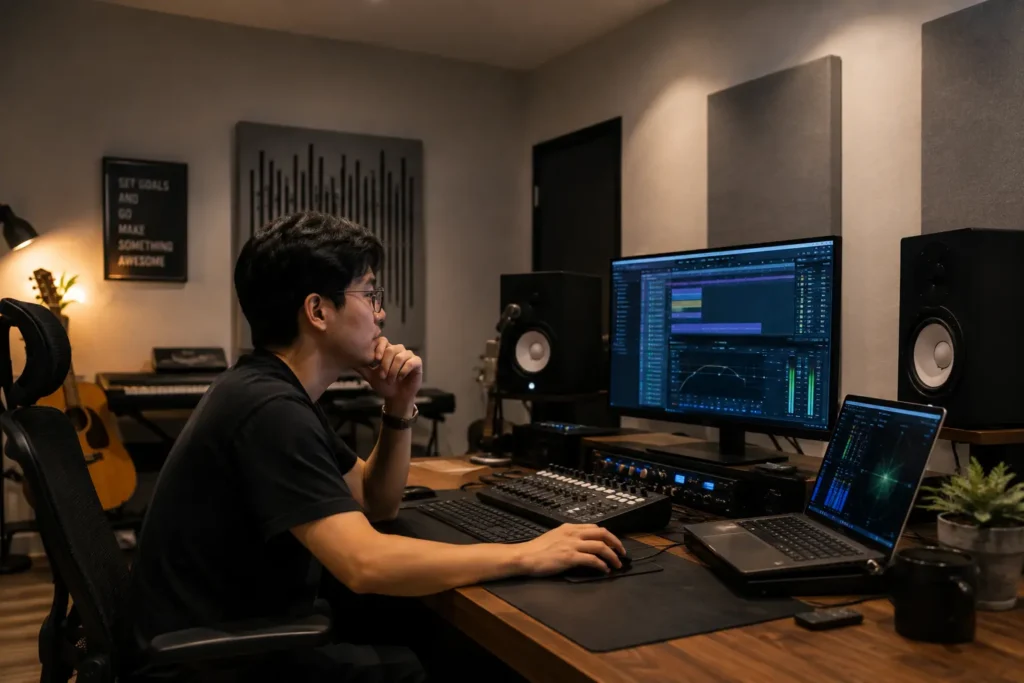
Your Equipment Isn’t the Only Thing You’re Hearing.
Your speakers produce sound.
Your microphone captures sound.
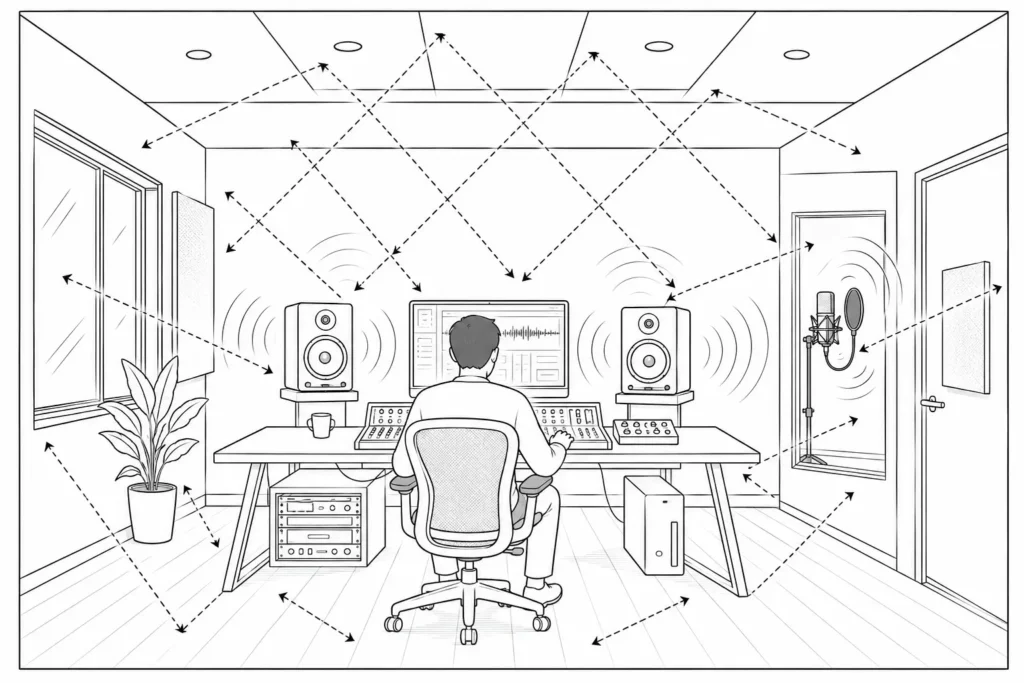
But the room becomes part of the system too. Sound reflects from Walls, Ceiling, Floor, Desk, Windows, Other hard surfaces
Some reflections arrive very quickly and affect clarity.
That’s why the same speakers or microphone can behave very differently in different rooms.
A Better Studio Should Help You Trust What You Hear.
A good studio doesn’t just make things sound better.
It gives you a more reliable environment for recording, listening, and making decisions.
Clear
Hear details in your recordings and mixes without the room getting in the way.
Balanced
Low, mid, and high frequencies feel more consistent from your listening position.
Controlled
Reflections are managed instead of dominating what you hear.
Reliable
Your decisions in the studio translate more predictably to other listening environments.
How to Improve Your Home Office
You don’t need to turn a room in your home into a recording studio.
Start by controlling the sound that matters most.


Control Reflections at Your Position
Early reflections from nearby walls, ceilings, and other hard surfaces can affect clarity and make it harder to judge what you’re hearing.
Acoustic panels can help absorb unwanted reflections and improve clarity around the listening and recording area.
Don’t Overlook the Low End
Low frequencies behave differently from mid and high frequencies.
In small rooms, bass can build up in some spots and feel weak in others, making it hard to judge low-end balance accurately.
This usually needs more than just adding wall absorption.
In some rooms, low-frequency treatment may be needed.
Build a Studio You Can Trust What You Hear In
The best acoustic treatment depends on how you use the room.
Mixing, vocal recording, podcasting, and instrument recording all have different needs.
You don’t need to treat every surface.
Focus on improving the areas that matter most for your work.
Simple ways to improve your studio
Choose a starting point based on your situation.
Acoustic Panels
For controlling unwanted reflections and improving clarity in your studio.
Works well for:
checkHome studios
checkPodcast rooms
checkVoice recording
checkContent creation
checkMonitoring spaces
Not Sure? Start Here
Acoustic Advice
Not sure what your studio needs?
Tell us about your room and setup. We’ll help you find where acoustic treatment will make the biggest difference.
checkSmall rooms with uneven sound
checkRoomy vocal or instrument recordings
checkBass buildup or missing low end
checkUnsure where to start
Frequently Asked Questions
Because acoustic panels don’t solve every acoustic problem.
Typical acoustic panels are mainly used to control mid- and high-frequency reflections. They can make a room clearer, but they may not be enough to deal with low-frequency buildup, room modes, or uneven bass response.
In a small studio, you may reduce the obvious echo and still have bass that feels too strong in one position and too weak in another.
When the room still sounds uneven after adding panels, the next step isn’t necessarily more panels, it may be better low-frequency control and a more balanced treatment approach.
Start with the problem you’re hearing.
Too much echo or strong reflections?
→ Absorption can help control unwanted reflected sound.
Bass feels boomy, weak, or different from one position to another?
→ Low-frequency treatment/bass traps may be needed.
The room feels overly controlled, flat, or lacks a natural sense of space after reflection control?
→ Diffusion can help redistribute reflections and maintain a more balanced acoustic character.
These treatments do different jobs. A well-designed studio often uses a combination rather than relying on just one type.
The right question isn’t “Which product should I buy?”, it’s “What is the room actually doing wrong?”
Possibly, especially if low-frequency problems are still present.
Acoustic panels can be very effective at controlling mid- and high-frequency reflections, but low frequencies behave differently. They can build up strongly in certain parts of a small room and create large differences in what you hear from one position to another.
That’s why a room can sound much less echoey after adding panels but still have:
• Too much bass in some areas
• Weak bass in others
• Certain notes that seem to linger
• Difficulty judging the low end of a mix
Bass traps are designed to address this lower-frequency energy more effectively than typical broadband wall treatment.
It depends on how the room is being used and how much reflection control is already needed.
Absorption is typically used to reduce unwanted reflections and improve clarity. Diffusion works differently: rather than simply removing sound energy, it helps scatter reflections so they are distributed more evenly through the space.
A studio that relies entirely on absorption can sometimes become overly dry or controlled, particularly if treatment is added without considering the room as a whole.
Diffusion can be useful when you want to control reflections without making the room feel acoustically lifeless.
However, diffusion is not a substitute for fixing serious reflection or low-frequency problems. It works best when the room already has an appropriate level of acoustic control and there is enough space for the diffuser to work effectively.
Start with the problems that are most likely to affect your recording or mixing decisions.
For many small studios, a sensible starting point is:
1. Control the most problematic reflections
Start with the key areas around the listening or recording position.
2. Address obvious low-frequency problems
If bass is uneven or builds up strongly, allocate part of the budget to appropriate low-frequency treatment.
3. Add diffusion where the room and application justify it
Diffusion is usually about refining the acoustic balance rather than being the first treatment to install.
You don’t need to buy everything at once.
A smaller amount of correctly chosen treatment is usually more useful than filling the room with products that aren’t addressing the actual problem.