
Make conversations easier to hear, reduce echo, and make meetings more comfortable.
Does your meeting room sound like this?
The room looks fine.
But conversations don’t always feel clear.
You may notice:
→ People often ask, “Sorry, can you repeat that?”
→ Voices sound slightly echoey.
→ Online meetings feel harder to follow.
→ People at the other end of the table are harder to hear.
→ Long meetings feel more tiring than they should.
If several of these sound familiar, your room may need better acoustic control.

Why does this happen?
The problem isn’t always volume.
It’s what happens to the sound inside the room.
When reflections arrive too close together, speech becomes harder to understand.
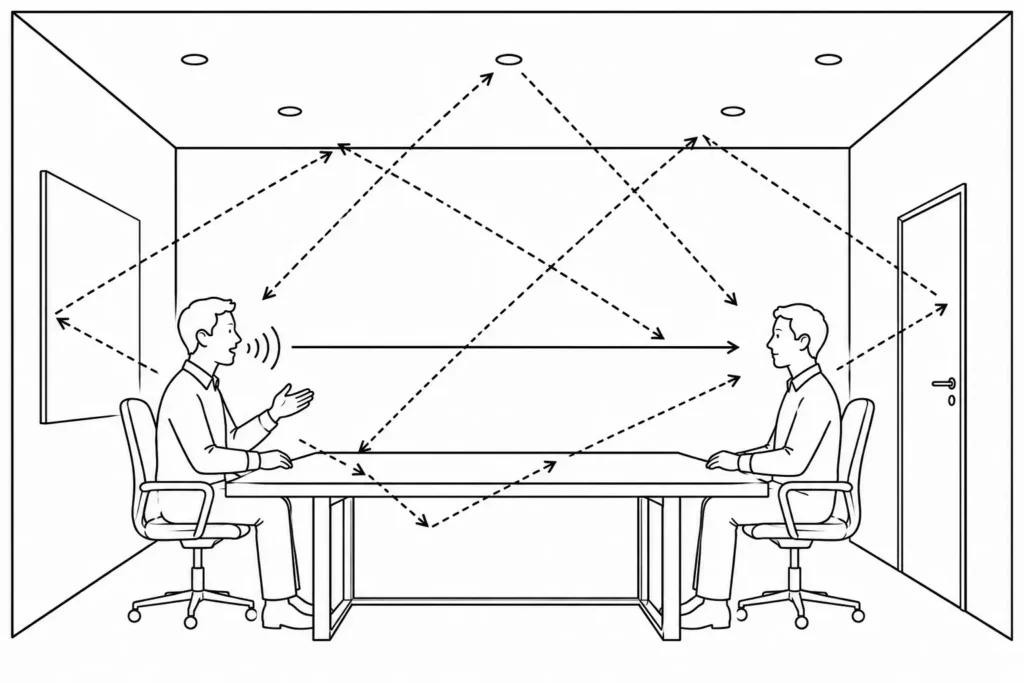
A better meeting room should feel easier to listen in.
Good meeting room acoustics aren’t about making the room completely silent.
They’re about making speech:
Clear
People can follow conversations without constantly asking for repeats.
Comfortable
Less echo means less effort spent trying to understand what people are saying.
Natural
The room still sounds alive, not overly damped or “dead”.
Consistent
People around the table can hear each other more easily.
How to Improve Your Meeting Room
You don’t need to cover every wall. Start with the surfaces that matter most.


Reduce Reflections
Absorb unwanted reflections around the meeting area to help speech stay clear.
Treat the Right Surfaces
Target the areas where sound bounces most strongly instead of treating the whole room.
Don’t Over-Treat
More absorption doesn’t always mean better acoustics.
Simple ways to improve your meeting room
Choose a starting point based on your situation.
Acoustic Panels
For a straightforward acoustic problem
If your meeting room mainly suffers from echo or unclear speech, acoustic panels can help control reflections and improve speech clarity.
Works well for:
checkEcho
checkSpeech clarity
checkHard-surface rooms
checkMeeting rooms with excessive reflections
Not Sure? Start Here
Acoustic Advice
Not sure what your room needs?
Every room is different. Tell us about your space and we’ll help you figure out where the problem is and what kind of solution makes sense.
Best for:
checkYou’re not sure what’s causing the problem
checkUnusual room layouts
checkNoise / privacy concerns
checkYou want a recommendation before buying
Frequently Asked Questions
Yes, when excessive reflections and reverberation are making speech harder to understand.
Acoustic treatment helps reduce unwanted sound reflections, so voices become clearer and less “mixed” with the sound of the room. This can make conversations easier to follow, especially when several people are speaking or when the room is used for presentations and online meetings.
The goal isn’t to make the room silent, it’s to make speech easier to hear and understand.
Not necessarily.
You don’t need to cover every wall to improve the room. The focus should be on the surfaces and areas that contribute most to unwanted reflections and reverberation.
A well-planned treatment can often achieve a noticeable improvement without turning the entire room into an acoustic installation.
There isn’t one fixed amount that works for every meeting room.
The right amount depends on factors such as room size, ceiling height, wall and ceiling finishes, furniture, occupancy, and how the room is used.
What matters is achieving the right level of acoustic control, not simply adding as many panels as possible.
If you’re unsure, we can help you identify where treatment would make the biggest difference.
Not when it’s properly planned.
Acoustic treatment is designed to control excessive reflections, not remove every sound from the room. A balanced approach can improve speech clarity while keeping voices sounding natural and comfortable.
Good acoustics is about balance, not maximum absorption.
Not usually.
Acoustic panels mainly control sound inside the room by reducing reflections and reverberation. They don’t normally stop noise travelling through walls, doors, ceilings, glass or other building elements.
If the problem is noise coming into the meeting room, rather than echo inside it, you may need a different approach such as sound isolation or noise control.