
Work from home with clearer calls, less echo, and a more comfortable space to focus.
Is Your Home Office Getting in the Way of Your Work?
Your room may look perfectly fine.
But when you start a video call or try to concentrate, you may notice:
Your voice sounds echoey
Your microphone picks up the room as much as it picks up your voice.
People ask you to repeat yourself
You can hear them clearly, but your voice doesn’t come through as naturally.
Your calls sound different from how you sound in person
The room adds reflections that make speech feel hollow or unclear.
The room feels fine until you start working
A room that feels comfortable for everyday living isn’t always comfortable for focused work or online communication.
If several of these sound familiar, your room may need better acoustic control.

Why Does a Room That Sounds Fine at Home Sound Bad on a Call?
The problem is often the room, not the microphone.
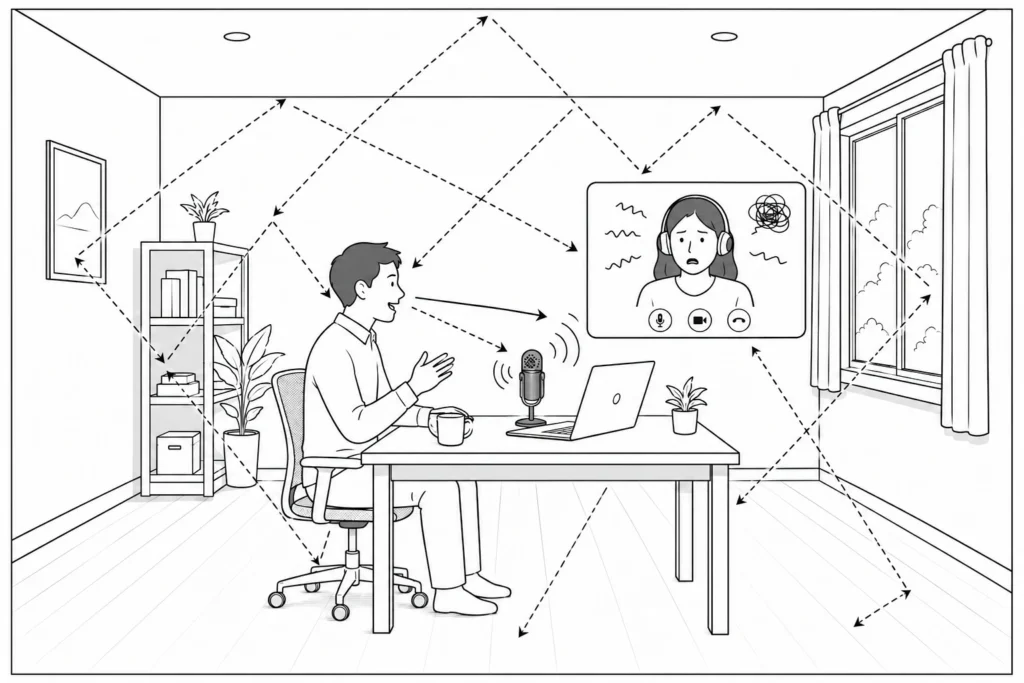
When your voice leaves your mouth, part of the sound travels directly to the microphone, but some of it reflects off Walls, Ceiling, Windows, Floors, Desks, Other hard surfaces.
Those reflections arrive shortly after your direct voice and become part of what the microphone captures.
And because video calls depend heavily on microphones, room acoustics can become much more noticeable than during a normal face-to-face conversation.
A Better Home Workspace Should Feel Easier to Work In.
Good home acoustics isn’t about making your room completely silent.
It’s about creating a space that works better for the way you use it.
Clear
Your voice sounds more natural and easier to understand on calls.
Focused
Less distracting background sound around your workspace.
Comfortable
The room doesn’t feel overly echoey or harsh.
Natural
Your voice still sounds like your voice, just with less of the room getting in the way.
How to Improve Your Home Office
You don’t need to turn a room in your home into a recording studio.
Start by controlling the sound that matters most.



Reduce Echo Around Your Voice
Acoustic treatment can reduce unwanted reflections from walls and other hard surfaces around your workspace.
This can help improve speech clarity and reduce the echo you hear and send through your microphone.
Treat the Area Around Your Workspace
Focus on the surfaces around the area where you speak, listen, and spend most of your working day.
The goal is to improve the acoustic environment around your normal position, not cover the room just for the sake of it.
Make Your Workspace Feel More Separate
If noise from another part of the home is distracting you, the solution may also involve how your workspace is positioned or separated from other activities.
Where appropriate, acoustic screens or partitions can help create a more defined working zone.
Simple ways to improve your home office
Choose a starting point based on your situation.
Acoustic Panels
For rooms that sound echoey or where online calls lack clarity.
Works well for:
checkVideo calls
checkWork from home setups
checkContent creation
checkSmall rooms with hard surfaces
Not Sure? Start Here
Acoustic Advice
Not sure what your home office needs?
Tell us about your room and we’ll help you figure out where acoustic treatment could make the biggest difference.
Best for:
checkShared home spaces
checkPersistent noise problems
checkUnsure where to start
Frequently Asked Questions
Yes. When room reflections are affecting your voice, acoustic treatment can reduce the amount of reflected sound captured by your microphone and help speech sound clearer and more natural.
Not necessarily.
For a typical home workspace, it often makes more sense to focus on the area around where you work and speak rather than treating every surface.
Not necessarily.
Acoustic solutions can be designed to work with your home’s existing interior rather than making the space feel overly technical.
Not usually.
Acoustic treatment mainly helps control sound inside your room. If noise is travelling through walls, doors, windows or ceilings, a sound isolation solution may be more appropriate.
A better microphone can improve audio quality, but it cannot remove room reflections noise.
If the room is the main problem, improving the room can often make a bigger difference to how your voice is captured.