
Great equipment can only sound as good as the room allows.
Control reflections, manage low frequencies, and shape the room for clearer, more immersive sound.
The Room Is Part of Your Sound System
Not sure what you need?
Get a recommendation →
Your System May Be Good.
The Room May Be Getting in the Way.
You have the speakers.
You have the subwoofer.
You have the screen, projector or TV.
But something still doesn’t sound quite right.
Dialogue gets lost
Movie dialogue doesn’t sound as clear as it should, especially during busy scenes or when background music gets louder.
Bass feels too strong in some places
One seat sounds boomy, while another feels like the bass has disappeared.
Music sounds harsh or overly reflective
Voices, instruments and effects seem to bounce around the room instead of sounding controlled.
Your KTV vocals don’t feel natural
The room adds too much reflection, making singing feel harder and less comfortable.
The room sounds very different from what you expected
The system sounded impressive during the demo but not quite the same once installed at home.
If this sounds familiar, the problem may not be your equipment. It may be the room.
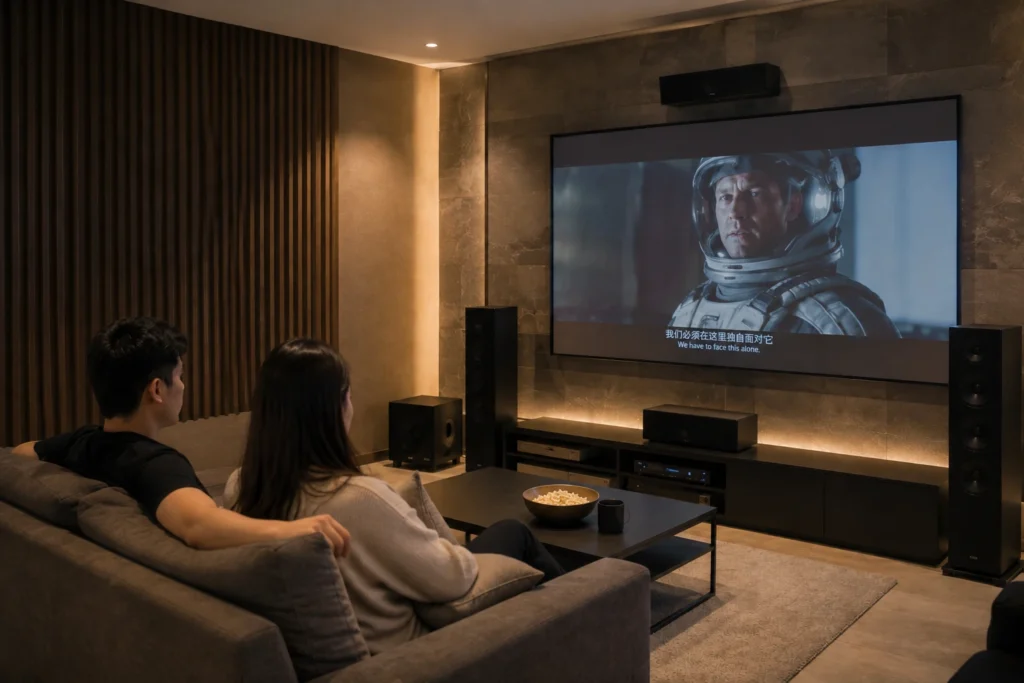
Your Speakers Don’t Sound in Isolation.
What you hear at home is not just the sound from your speakers. It is shaped by the interaction between your speakers, the room and your listening position.
As sound travels through the room, it interacts with walls, the ceiling, floor, glass, furniture and other hard surfaces. Some sound reaches you directly, while some reflects around the room before reaching your ears.
In other words, the room becomes part of what you hear. That’s why the same speakers can sound very different in different rooms.
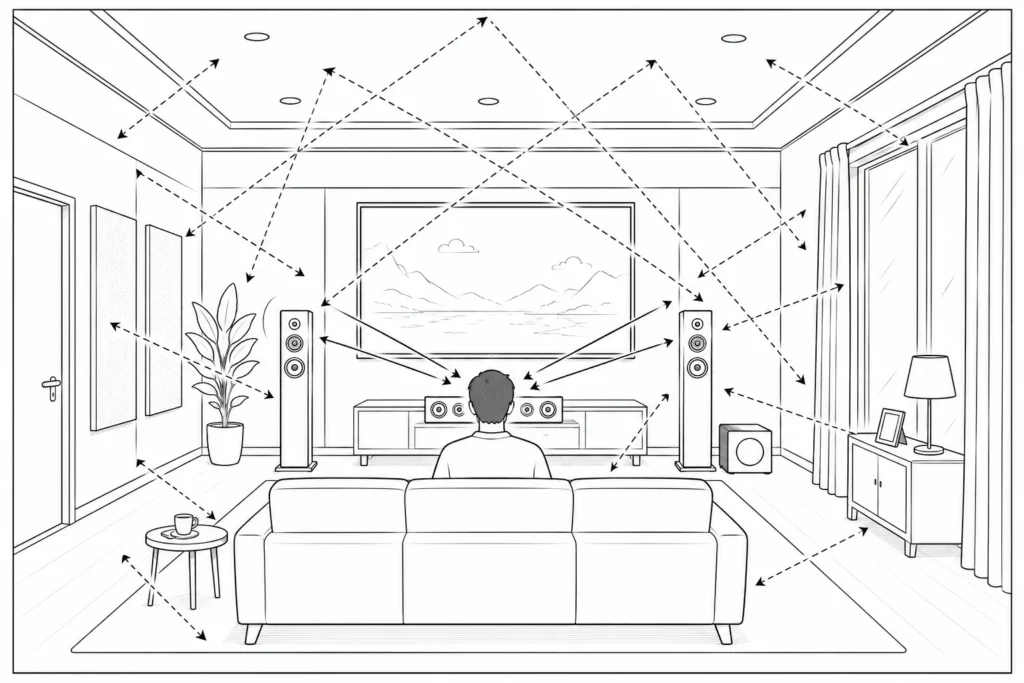
Sound Doesn’t Stop When It Leaves the Speaker.
Reflections affect clarity
Early reflections from nearby surfaces can interfere with the direct sound and affect how clearly you hear dialogue, vocals and detail.
Low frequencies behave differently
Bass can build up unevenly in a room, creating areas that sound too heavy and others that sound weak.
Uncontrolled reflections change the room’s character
A space can sound bright, harsh, echoey or overly lively even when the equipment itself is performing well.
Too much absorption can create another problem
Controlling a room is not about absorbing everything.
The goal is to find the right balance for the way the room is used.
Different Experiences.
Different Priorities.
The acoustic foundation is similar, but the room is ultimately supporting a different experience.
HOME THEATRE
Hear More. Feel More.
A good home theatre room should help you follow dialogue, appreciate detail and experience the soundtrack as intended.
Acoustic priorities may include:
Dialogue clarity
Keep speech clear against music and effects.
Reflection control
Reduce unwanted reflections that affect clarity and imaging.
Low-frequency control
Manage bass buildup so subwoofer energy feels more consistent.
Balanced reflection
Maintain an immersive room without making it overly dry.

KTV
Sing Comfortably. Keep the Energy.
A good KTV room should feel lively and enjoyable while keeping vocals clear enough to sing comfortably.
Acoustic priorities may include:
Vocal clarity
Control excessive reflections so voices don’t become harsh or muddy.
Room control
Reduce excessive echo while keeping the room energetic.
Low-frequency management
Control bass buildup from subwoofers and playback systems.
Comfort at higher sound levels
A better-controlled room can feel less harsh and tiring during longer sessions.

Simple ways to improve your room
Choose a Starting Point Based on What You’re Hearing.
Acoustic Panels
For controlling unwanted reflections and improving clarity.
Works well for:
checkDialogue
checkVocals
checkMusic
checkGeneral reflection control
Bass Traps
For rooms where low-frequency energy is uneven or excessive.
Works well for:
checkBoomy bass
checkBass buildup
checkUneven bass response
checkSubwoofer-heavy rooms
Diffusers
For shaping reflections while maintaining a more natural sense of space.
Works well for:
checkListening rooms
checkHome theatres
checkMusic rooms
checkSpacious rooms
Not Sure? Start Here
Acoustic Advice
Not sure what your room needs?
Every room behaves differently.
Tell us about your room, equipment and listening concerns. We’ll recommend the most suitable treatment.
Frequently Asked Questions
A good sound system cannot control the room it is installed in.
Speakers, subwoofers and amplifiers produce the sound, but the room determines how much of that sound is reflected, absorbed and accumulated before it reaches you.
Acoustic treatment helps control the room so you can hear more of what the system is actually producing.
It depends on what the room is doing wrong.
If reflections and echo are the main problem, absorption may be appropriate.
If low frequencies are excessive or uneven, low-frequency treatment may be more important.
If the room is already reasonably controlled and you want to manage reflections while maintaining a more natural acoustic character, diffusion may be worth considering.
Many rooms benefit from a combination rather than a single treatment type.
Not necessarily.
The goal isn’t to cover every available surface.
Treatment should be placed where it can address the acoustic problems that matter most for the room, the listening position and the way the space is used.
It shouldn’t when the room is properly balanced.
The goal is not maximum absorption.
A well-planned room should control excessive reflections while maintaining enough acoustic energy for the space to feel natural and immersive.
For some rooms, that means combining absorption with diffusion rather than simply adding more absorption.
Not by themselves.
Acoustic treatment primarily controls sound inside the room.
If the problem is sound travelling through walls, doors, ceilings, windows or other building elements, you may need a sound isolation or noise control approach instead.